Outlook Industri Sawit
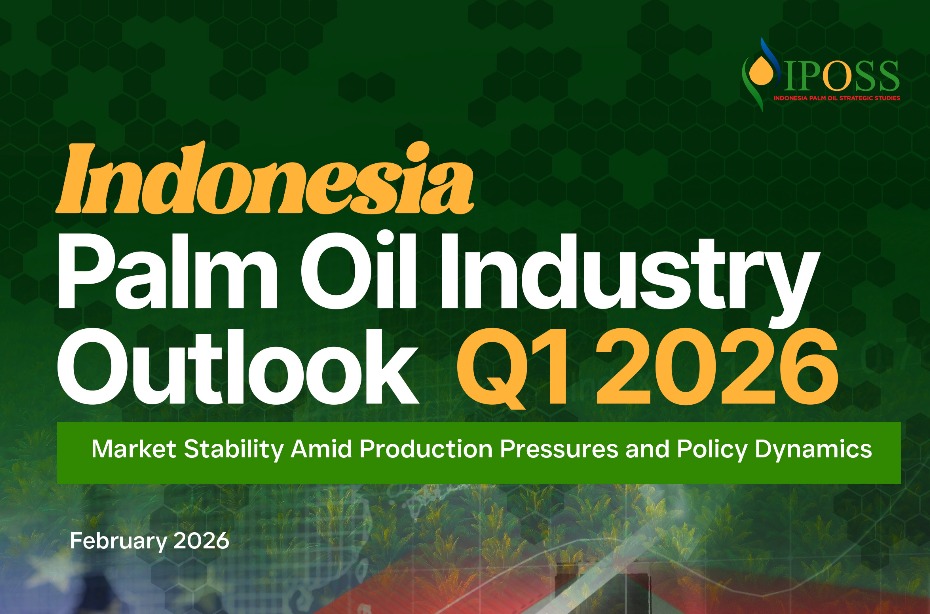
Palm Oil Industry Outlook Q1 2026: Market Stability Amid Production Pressures and Policy Dynamics
Terbit 27 Februari 2026 · Q1 2026
The Palm Oil Outlook Q1 2026 assesses that the Indonesian palm oil industry is entering the year in an increasingly complex market configuration that is sensitive to external dynamics. Domestic demand remains strong—particularly from the energy sector through the biodiesel program—while on the production side, regional pressures have emerged due to extreme weather and flooding in a number of areas in Sumatra. At the same time, adjustments to export fiscal policy and land management reforms are shaping a risk landscape that increasingly determines the direction of industry margins and investment perceptions.
Fundamentally, the supply-demand balance in January-March 2026 is relatively stable, although it is tighter than in previous surplus periods. Production has corrected slightly, domestic consumption remains solid, and stocks are not too loose. In the global market, CPO prices are moving steadily to moderately stronger, with high sensitivity to energy volatility and geopolitical dynamics.
This outlook also examines the implications of changes in the Reference Price, Export Levy, and Export Duty, including plans to increase the export levy tariff to 12.5% starting in March 2026, as well as their impact on the export cost structure and domestic price transmission. The 2025 export market evaluation, the impact of flooding on national production, and the interaction of domestic policies with global dynamics are also important parts of the analysis.
Overall, Q1 2026 is not a period of supply crisis, but rather a phase of structural consolidation. The Indonesian palm oil industry is stable in terms of volume, but increasingly sensitive to changes in margins, fiscal policy, and global volatility. The direction of the first half of 2026 will be largely determined by the ability to maintain a balance between the stability of the biodiesel program, governance certainty, and price competitiveness in an increasingly integrated and competitive global market.